
The Best of Morocco Begins After the First Impression

Everyone has a picture of Morocco before they arrive.
The maze of the medina.
The color.
The carpets.
The lanterns.
The call to prayer drifting over rooftops.
The shimmering desert stretching toward the horizon.
And yes, Morocco is all of those things.
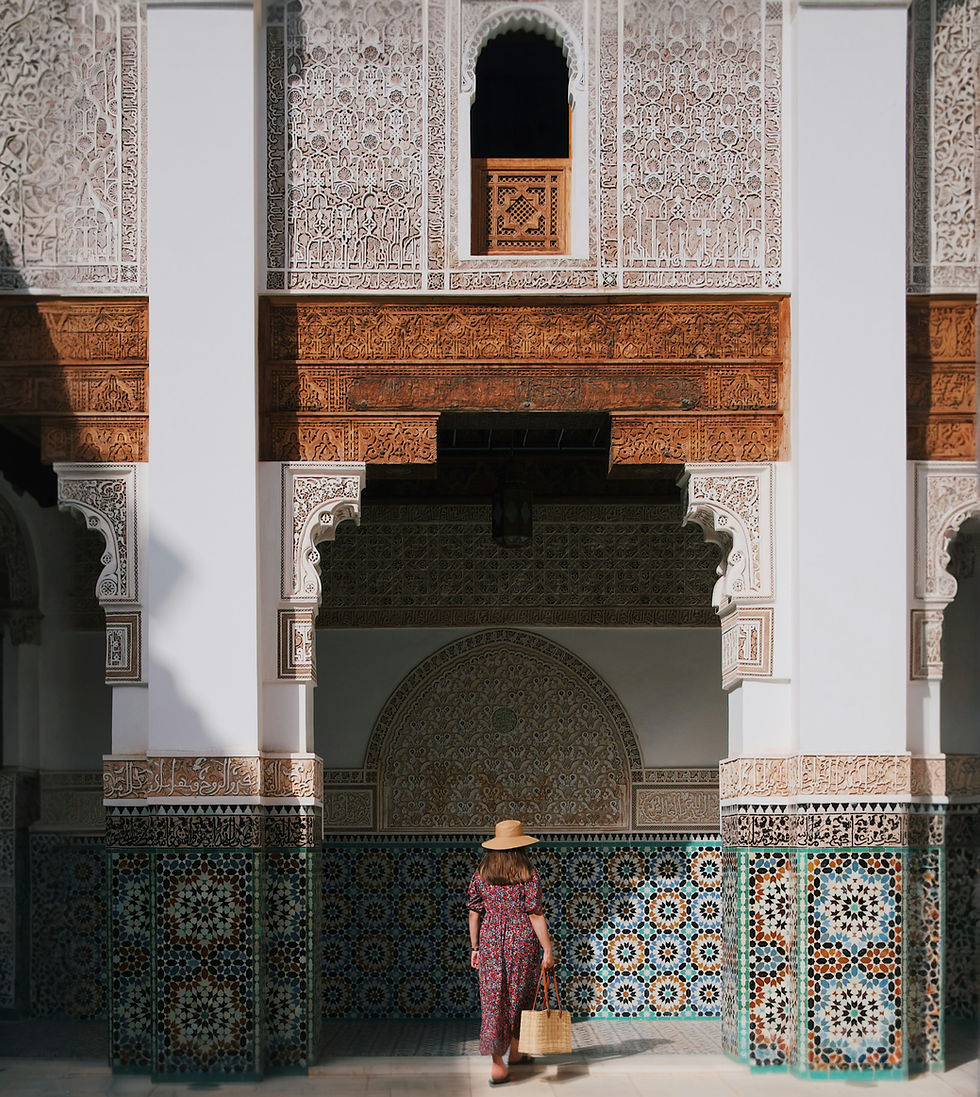
It is dramatic and beautiful, full of the details travelers often imagine when they think of a luxury vacation to Morocco: carved doors, patterned tile, spice stalls, rooftop terraces, narrow alleys that seem to turn in on themselves.
But Morocco’s first impression is not the whole story.
For many travelers, it is the second impression that stays.
The first one is visual.
The second is personal.
Beyond the First Rush
Morocco can feel like a lot at first.
In Marrakech, motorbikes slip through narrow lanes, and shopkeepers call from open doorways.
Brass and leather seem to glow in the stalls.
The scents of saffron, rose, amber, and mint show up everywhere, sometimes before you even know where they are coming from.
It is easy to think the experience is about taking it all in.
And part of it is.
You should wander, and you should look closely.

You should notice the sunlight in the tiled courtyard, and the way an ordinary-looking doorway opens into a space you never would have guessed was there.
You should notice the way a city can feel ancient and entirely alive at the same time.
But Morocco becomes more interesting when the pace changes, when you are no longer trying to absorb everything at once, and someone invites you to sit down.
That small glass of mint tea is not just refreshment. It changes the rhythm.
A quick stop becomes a conversation. A conversation becomes the part of the day you did not know you needed.
That is when Morocco begins to feel less like a place you are moving through and more like a place that is opening up to you.
How Morocco Reveals Itself Through Doors
Some destinations reveal themselves through landmarks.
Morocco often reveals itself through thresholds.
A plain wall on a narrow street opens into a riad with orange trees, carved plaster,
and the sound of water somewhere nearby.
In Fes, a busy souk might give way to a tile workshop where an artisan explains how a zellige pattern is cut and fitted by hand, not as a performance for visitors, but as something he has done for so long it is part of the way he sees the world.
A drive into the Atlas Mountains brings cooler air, wider views, and lunch on a terrace where bread is still warm, olive oil is poured generously, and no one seems to understand why a meal should be rushed.
These are not always the moments people picture when they first dream of Morocco.
But they are often the ones they remember.
Because suddenly the country is no longer just something to admire.
It becomes somewhere you have been welcomed.
The Luxury of the Right Pace
Luxury in Morocco is not only found in beautiful hotels, though Morocco has some extraordinary ones.
It is found in contrast.
The hush of a quiet courtyard after the energy of the medina.
Dinner by candlelight after a day of movement and sound.
The stillness of the desert after the intricacy and throb of the city.
A guide who knows when to explain, when to translate, and when to let you simply be where you are.
That kind of travel rarely happens by accident.
It depends on pacing. On knowing when a day should be full and when it should be light.
It depends on choosing the right riad, the right guide, the right route, and the right moment to pause.
Morocco is not a destination to hurry through.
It asks for room: room for you to adjust, to be surprised, and to let the second impression arrive.
The Journey Between Morocco's Worlds
One of Morocco’s great gifts is how quickly the atmosphere changes.
You can begin in the intensity of Marrakech, then find yourself in the Atlas Mountains, where the landscape opens and the air feels different.
You can move from a centuries-old medina to a quiet terrace; from intricate interiors to the open edges of the Sahara; watch the day soften, the camels settle, and the silence feels almost palpable.
And each new scene changes how you understand the place before it...the city feels more alive after you've been to the mountains, and the desert feels more expansive after the city.
A quiet meal feels more generous and welcome after a day of walking, bargaining, listening, and trying to take it all in.
That rhythm matters.
Handled well, Morocco is not a collection of stops. It is a progression, where each place prepares you for the next.
And somewhere along the way, the journey becomes less about what Morocco looks like and more about how it feels to be there.
What You Carry Home
You may go to Morocco for the color, for the architecture, the markets, the mountains, the desert, the food.
All good reasons.
But what you may remember most is something quieter.
Like the way someone welcomed you into a space you never would have found on your own.
Or the way a guide helped you understand what you were seeing, not by reciting facts, but by giving it context.
The way a courtyard felt like a hidden secret, or the way the country kept opening, one door after another.

That is the hidden advantage of Morocco.
It may be even more beautiful than you expected. But beyond the beauty, there is warmth. There is welcome.
There is the feeling of being let in, even briefly, to a world that cannot be fully understood from the outside.
The first impression may be what draws you to Morocco.
The second is what makes it unforgettable.
If Morocco has been lingering somewhere on your wish list, this is the kind of journey worth planning with care: one with time to wander, room to pause, and the right people in place to help the country reveal itself.



Comments